Leave Your Message
-
Phone
-
E-mail
-
Whatsapp

-
Whatsapp

When it comes to soap packaging boxes, they really gotta do a good job of protecting that soap bar—preventing scuffs, keeping moisture out, and surviving handling. But at the same time, they should make it easy for folks to recognize the scent and the brand. If you're buying this stuff globally, finding a reliable supplier is key—one who offers consistent print quality, the right dimensions, and clear sample processes. Those tiny details really matter—like a crushed corner or a crooked label can mess up the whole look of an otherwise premium product.
According to Smithers’ The Future of Global Packaging to 2028, the worldwide packaging market is expected to hit over US$1.2 trillion by that year. But keep in mind, that’s a broad projection and isn’t specifically about soap boxes. So, it’s more useful as background info rather than a direct sales forecast. If you wanna dig deeper, Euromonitor International’s research on consumer goods can give you a better idea of market differences by category. Basically, don’t just focus on price—consider materials, production capacity, and how quickly they can deliver regionally. It’s a good idea to ask for printed samples and see if the box holds up after handling it a bunch of times.
Walter Soroka, a packaging expert and author of Fundamentals of Packaging Technology, points out that packaging’s main jobs are protecting the product, aiding in distribution, and conveying your brand message. That’s a pretty useful way to think when you’re checking out the top soap packaging suppliers globally. Be sure to ask each one about their board options, printing tolerances, lead times, and quality checks. No supplier is perfect, so always verify their claims with actual samples and detailed specs. And hey, if you’re also using soap packaging bags, make sure they match the branding and colors so everything stays consistent and professional-looking.

Top 10 Soap Packaging Boxes Suppliers for Global Buyers
The global soap market reached USD 47.08 billion in 2023, according to Grand View Research. This scale creates strong demand for reliable packaging suppliers worldwide. Soap boxes now protect products, communicate quality, and support practical retail handling. A weak box can damage soap during humid transport. That small failure can affect customer trust.
Experienced buyers should examine more than price. They should check board thickness, moisture resistance, print accuracy, and carton strength. A suitable supplier can provide samples before full production. Ask for compression testing and color references. These details matter when boxes travel through ports, warehouses, and crowded store shelves.
Material choices also deserve careful review. Recyclable paperboard may support sustainability goals, but it still needs enough strength. Water-based coatings can improve surface protection, although performance varies by climate. I have found that packaging discussions often focus too much on appearance. That is a mistake. A beautiful box may still collapse under stacking pressure. Buyers should compare minimum order quantities, lead times, quality inspections, and export documentation. Communication speed matters too. Delays become expensive quickly.
No supplier is perfect. Even a careful production plan can face paper shortages or color variation. Buyers should request clear tolerances and written corrective procedures. Transparent records build confidence. A practical shortlist of ten qualified suppliers should reflect tested performance, not only attractive catalogs.
| No. | Supplier Category | Common Soap Packaging Output | Typical Material or Process | Buyer Checks |
|---|---|---|---|---|
| 1 | Folding carton manufacturers | Printed cartons for single bars, multipacks, and gift sets | Folding boxboard or other paperboard, printed and converted into cartons | Confirm board grade, carton dimensions, print specifications, and whether the carton is suitable for the product’s moisture conditions. |
| 2 | Recycled paperboard converters | Cartons and sleeves for standard bar soaps and bundled products | Paperboard made with recycled fiber; available grades and recycled content vary by supplier | Request documented recycled-content information and check local recycling acceptance for the finished package. |
| 3 | Kraft paper packaging suppliers | Simple cartons, wraps, sleeves, and paper bags | Kraft paper or kraft paperboard, sometimes with a printed or coated surface | Ask whether coatings, inks, windows, or adhesives affect recyclability in the destination market. |
| 4 | Corrugated box manufacturers | Shipping cartons and protective outer boxes for wholesale orders | Corrugated fiberboard, consisting of fluted paper between liner sheets | Specify box dimensions, board construction, stacking needs, and the shipping environment. |
| 5 | Rigid paperboard box makers | Presentation boxes for premium bars, assortments, and gift packs | Thick paperboard with a wrapped or printed outer surface | Check box construction, closure style, assembly method, and the amount of material used. |
| 6 | Paper sleeve and wrap converters | Band sleeves and wraps designed to leave part of the soap visible | Printed paper or lightweight paperboard converted into bands or wraps | Verify fit across bar-size variations and ensure required product information remains legible. |
| 7 | Molded fiber packaging suppliers | Protective inserts, trays, or presentation components for soap sets | Molded pulp or other formed fiber materials; composition depends on the supplier | Ask for material composition, moisture performance, surface finish, and disposal guidance for the destination market. |
| 8 | Flexible paper packaging converters | Paper-based wraps or pouches for individual bars and bundled products | Paper structures, sometimes combined with coatings or other layers | Request the full material structure and confirm whether the package is recyclable where it will be sold. |
| 9 | Custom die-cut packaging suppliers | Custom-shaped cartons, display boxes, and packaging with product windows | Die-cut paperboard, with optional windows, inserts, or specialty finishes | Check window material, dieline approval, structural samples, and compatibility with packing equipment. |
| 10 | Packaging design and converting partners | Packaging development from structural design through printed-box production | Materials and converting processes selected for the requested design and production run | Clarify which production steps are performed in-house, sample approval stages, and quality-control requirements. |
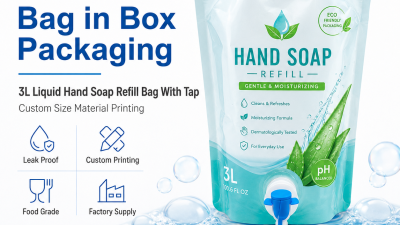
Custom bag-in-box tap pouches offer a smarter way to refill liquid hand soap while reducing the drawbacks of rigid containers. Each 3L pouch uses food-grade composite film with reinforced heat-sealed edges and a secure dispensing tap to help prevent leaks during transport, storage, and everyday use. Its lightweight, foldable structure requires less space than bottles, helping lower shipping volume and handling costs. According to the U.S. Environmental Protection Agency’s *2018 Facts and Figures Report*, containers and packaging accounted for approximately 82.2 million tons of municipal solid waste, making material reduction an important consideration for personal-care packaging.
Designed for bathrooms, retail refill stations, hospitality facilities, and home-care hygiene supplies, these pouches can be customized in size, film structure, tap configuration, and printed design. Their efficient format allows users to replace empty soap containers without repeatedly purchasing new rigid bottles, while the flexible pack collapses as the contents are dispensed. The World Bank’s *What a Waste 2.0* report estimates that global municipal solid waste generation could reach 3.40 billion tonnes annually by 2050, increasing demand for packaging systems that use resources more efficiently. Certified to BRCGS, ISO 9001, and ISO 22000 requirements, the pouches support safe bulk-liquid handling and consistent quality for international personal-care applications.
It supports packaging optimization, material reduction, and environmental impact assessment. A thinner box is not always better. A weak box may collapse around a wet soap bar.
Request chain-of-custody records and recycled-content evidence. Check whether the documents cover the actual paper grade. Paper proof alone is incomplete.
No. It mainly applies to compostable plastic products and coatings. It does not automatically certify paperboard boxes or home composting. Ask for current reports.
Pack a real soap bar inside the sample. Check odor, moisture resistance, print rubbing, and folding accuracy. Empty mock-ups can hide problems.
Review material minimization, recyclability, reuse, labeling, and producer-responsibility duties. Request material specifications, weight data, and recent audit records. Local guidance may differ.
It connects each shipment with materials, production records, and corrective actions. This helps identify inconsistent paper, coatings, or adhesives. Traceability matters.
No. Confirm that local facilities accept the complete packaging structure. Adhesives, inks, and coatings may affect recycling. A recyclable-looking box may fail locally.
An audit can reveal factory controls, but it cannot prove total compliance. A supplier may still miss a local registration requirement. That gap deserves attention.
The global soap market reached USD 47.08 billion in 2023, increasing the need for reliable Soap Packaging Boxes that protect products, support branding, and meet international shipping requirements. This guide explains how leading suppliers are evaluated through product quality, production capacity, minimum order quantities, customization options, and lead times. It also compares supplier capabilities by region and material, covering paperboard, corrugated board, recycled fiber, and compostable packaging solutions.
For global buyers, the article provides practical benchmarks for printing costs, order volumes, shipping expenses, and delivery schedules. It also highlights sustainable material requirements under ISO 18601, FSC, and ASTM D6400, helping purchasers assess environmental claims more effectively. In addition, supplier compliance with the EU PPWR 2025/40 and other international packaging regulations is reviewed, enabling buyers to select packaging partners that balance cost, durability, sustainability, and regulatory readiness.