Leave Your Message
-
Phone
-
E-mail
-
Whatsapp

-
Whatsapp

So, here we are in 2026, and picking the right Food Pack Box is honestly a bit of a juggling act. You’ve got to think about protection, presentation, storage, and how it’ll all be disposed of later. For dry snacks, a nice crisp folding carton usually does the trick. But if you’re shipping something heavier, you’ll probably want a corrugated box that can take a beating. Chilled stuff? That’s another story—you might need leak-resistant trays or even insulated packaging, depending on how far it’s traveling. At the end of the day, it’s not just about looking good on the shelf. It’s about the food itself, the journey it takes, and who’s on the receiving end.
Okay, so the whole packaging thing matters—maybe more than we give it credit for. FAO's 2019 report on food and agriculture found that around 14% of food gets lost somewhere between harvest and retail. And then UNEP's 2024 Food Waste Index dropped this stat: about 1.05 billion tonnes of food went to waste in 2022, which is roughly 19% of what consumers actually had available. Now, packaging isn't going to fix food loss all by itself. But getting the fit right, cushioning products properly, and controlling moisture? Yeah, those can genuinely help.
Market reports are useful, but they only give you one angle. Smithers’ The Future of Global Packaging to 2028, for example, digs into how materials and packaging formats are changing—still, a forecast isn’t a promise. So this guide is more about comparing the real contenders: folding cartons, corrugated boxes, paperboard trays, molded-fiber packs, insulated boxes, you name it. And it gets down to the nitty-gritty. Think a greasy coating on your takeout box, a damp fridge shelf, or a package that shows up completely crushed. Little things like that matter. Honestly, no format is perfect. Just because a label says 'recyclable' doesn’t automatically mean your local facility can actually process the packaging, you know? Honestly, the best choice is still the one that keeps the food safe, fits into the supply chain without a headache, and can be handled responsibly once it’s done its job.
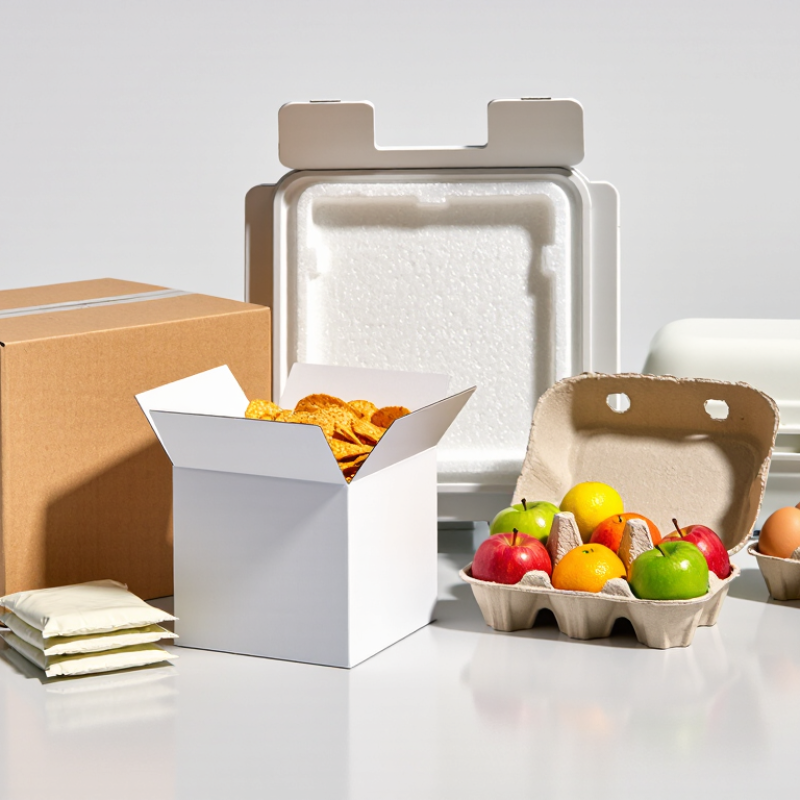
For 2026 food-box planning, paperboard cartons, corrugated boxes, and molded-fiber trays each serve different jobs. Folding cartons suit dry goods and lightweight items. Corrugated boxes offer more protection for heavier or shipped products. Molded fiber can hold individual portions, though its shape and finish may limit reuse.
The scale is easy to misread. The U.S. Environmental Protection Agency’s Advancing Sustainable Materials Management: Facts and Figures 2018 reported 41.9 million U.S. tons of paper and paperboard containers and packaging generated that year. That is substantial. But it is not a food-box tally. The category covers many kinds of packaging, not just boxes for food. I would not treat it as a direct measure of food-box demand.
For a specific product, check the box’s weight, moisture exposure, and contact with oils or sauces. A thin carton can work well on a dry shelf but soften near condensation. Coatings may also affect whether local recycling programs accept a package. The EPA figure gives useful context, not a packaging prescription. Pack A Box decisions need product-level testing, and one detail is often overlooked: a box that protects food well may be harder to sort after use.
Plastic made up 19.4% of EU packaging waste. This covers packaging across sectors, not food boxes alone.
They are lightweight, stack neatly, and help protect meals from leaks. A rigid box can also prevent food from being crushed.
Compare its weight, lid fit, and local recycling options. Pick the smallest box that safely fits the portion.
Not necessarily. Material, box size, and local recycling access all matter. A sturdy box can be overbuilt.
They can cushion meals and produce during delivery. Shaped walls and fitted compartments help limit movement and rubbing.
Fiber absorbs moisture and may soften after prolonged contact with damp food. The appearance can be misleading.
A barrier may slow leaks from chilled, oily, or hot foods. Ask what it contains and whether it suits the food, temperature, and contact time.
Check the complete finished package, not only its raw materials. Test actual portions, condensation, and stacking pressure. Lab results can miss delivery conditions.
Choosing the right Food Pack Box in 2026 means balancing product protection, delivery conditions, and local recycling options. Paper packaging is a major part of the food-box landscape: the EPA reported 41.9 million U.S. tons of paper packaging in 2018, while corrugated containers reached a reported U.S. recycling rate of 96.5% that year. Folding cartons and paperboard trays offer a range of grades and shapes for different foods, from lightweight portions to more structured packs.
Plastic boxes can suit products that need particular forms of containment, though plastic made up 19.4% of EU packaging waste in 2022, according to Eurostat. Molded-fiber boxes provide cushioning and may need moisture barriers, so their suitability depends on the food and appropriate food-contact checks. The best choice is not simply a material preference: consider the item’s fragility and moisture sensitivity, how far and under what conditions it will travel, and whether local recovery systems can handle the packaging.